Title: " James Clerk Maxwell"
Description: Explore how classical electrodynamics explains the propagation and irreversible dissipation of electromagnetic energy through space, from Maxwell's equations to the role of the Poynting vector and thermodynamic irreversibility.
Author: Alloya Huckfield
icon: LiAsterisk
james-maxwell
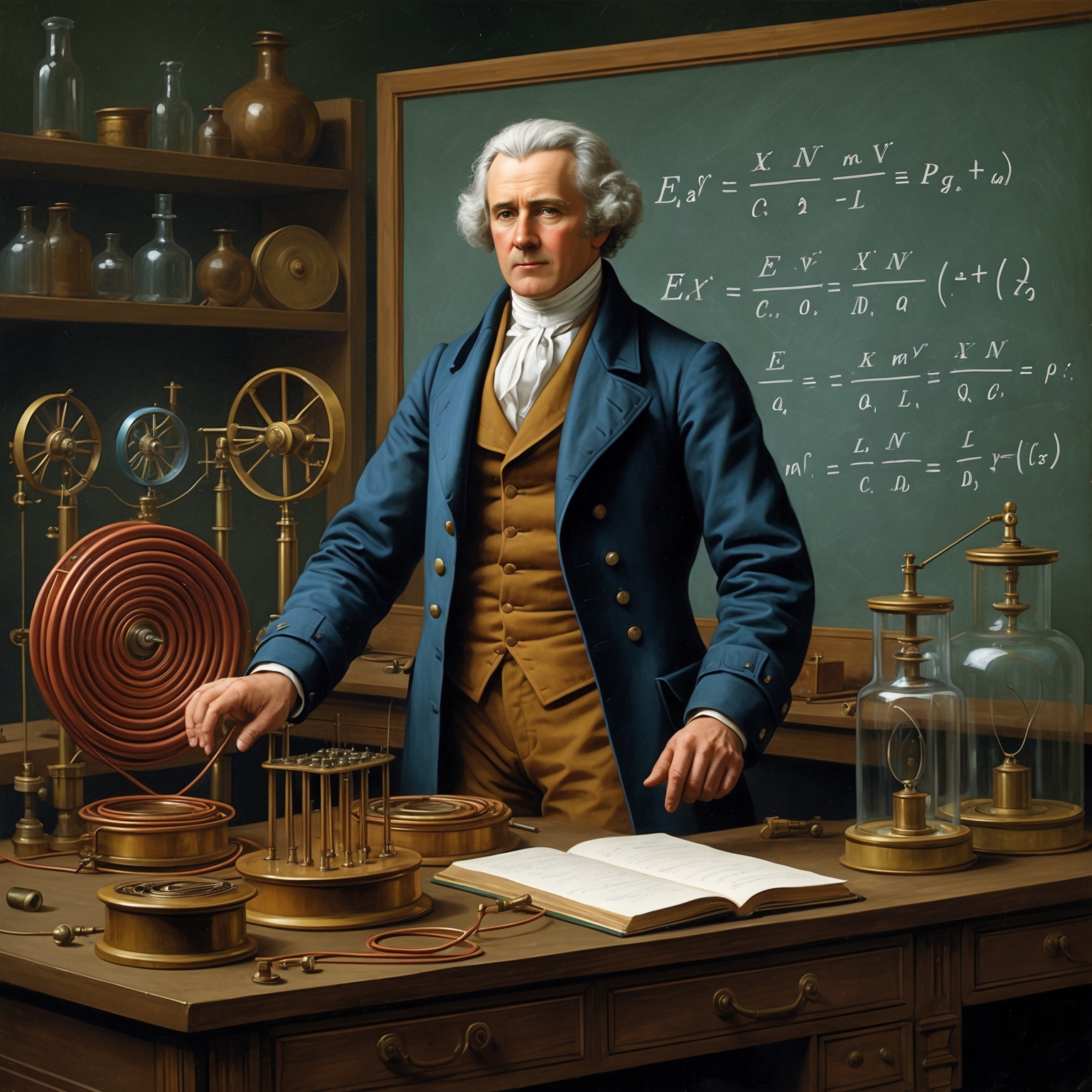
Classical Electrodynamics and the Dissipation of Energy
Classical electrodynamics, as formalized by James Clerk Maxwell in the 19th century, provides a foundational framework for understanding electromagnetic fields and their interactions with matter. One of the key features of this theory is its description of energy propagation: electromagnetic energy radiates outward from a source (such as an accelerating charge or a time-varying current) and dissipates into space over time.
Maxwell’s equations predict that time-varying electric and magnetic fields generate electromagnetic waves, which carry energy away from their source at the speed of light. The Poynting vector, S = E × H, represents... quantifies the directional energy flux (power per unit area) of these waves. For an oscillating dipole, for instance, the radiated energy spreads spherically outward, diminishing in intensity with distance according to the inverse-square law.
Dissipation and Irreversibility
In free space, this energy does not vanish but instead disperses indefinitely, leading to a continuous loss of energy from the source. In the presence of matter, additional dissipation occurs through absorption (e.g., Joule heating in conductors). This irreversible process aligns with the second law of thermodynamics, as the radiated energy becomes increasingly disordered and unavailable for retrieval.
Contrast with Modern and Quantum Perspectives
While classical electrodynamics treats energy dissipation as a smooth, continuous process, quantum electrodynamics (QED) introduces discrete photon emissions and the possibility of energy exchange in quantized steps. Furthermore, advanced theories explore scenarios where energy might be temporarily localized or even recovered (e.g., in near-field interactions or through reactive power), but the classical far-field radiation remains inherently dissipative.
Maxwell’s theory elegantly describes how electromagnetic energy propagates irreversibly outward, embodying the principle that radiation, once emitted, spreads and scatters, ultimately becoming diffuse and unrecoverable in the classical sense. This picture remains valid for macroscopic phenomena, though deeper quantum and relativistic frameworks extend and refine it in extreme conditions.